Jumper wires, rail-less breadboards, and switches you can actually latch
Movable-end jumper wires, stackable rail-less boards, a 4-pin tactile button and a DPDT latching switch, plus freeform wire bending and a proper right-click menu.
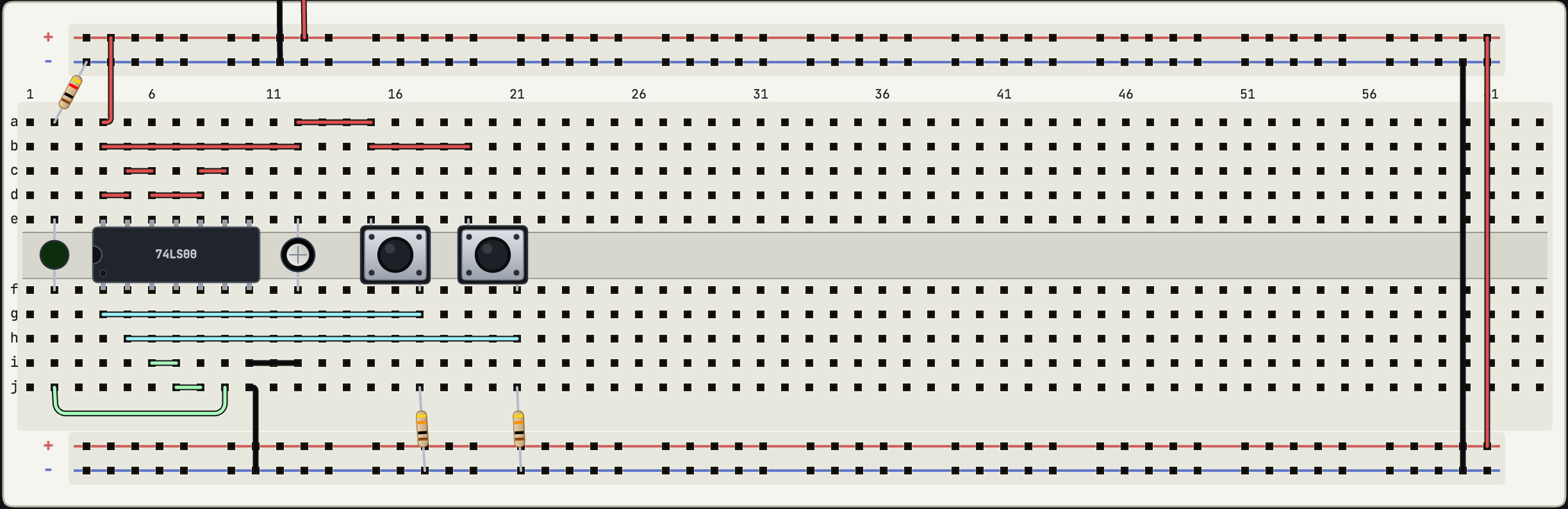
This release is about making the workbench feel like a workbench: the wires, boards, and switches you would grab from a real parts drawer, behaving the way the real ones do.
Jumper wires
Wires can now be jumpers: a plug on each end that you can pull out of one hole and push into another, exactly like the pre-cut jumpers in a breadboard kit. Any wire can convert to a jumper and back with no electrical change. It makes "move this one connection over a column" a two-second drag instead of a delete-and-redraw.
Rail-less breadboards
The 830 and 400 boards now come in rail-less variants: the terminal-strip core with the power-rail banks removed. Stack a rail-less board against a full board and let both share one set of rails, which is how larger multi-board builds are laid out on real benches. DIP chips still straddle the centre channel exactly as before.
Switches worth flipping
Two new parts in the Inputs group: a 4-pin tactile push button with the real pin pairing (the two pins on each side are internally joined, which is faithfully the thing that confuses everyone the first time they meet one on a real board), and a 6-pin DPDT latching push switch for the "push on, push off" behaviour that projects keep needing. Both are wired pin-for-pin like their physical counterparts.
Wiring quality of life
- Hold the modifier while drawing to bend a wire freeform where you want its corners.
- Right-click now opens a proper, dismissable context menu on parts and wires.
- Leaded parts (resistors, capacitors, diodes, LEDs) can span across two breadboards.
- Free-standing modules collide by their actual body outline, so parts stop overlapping in ways the real objects could not.
Fixes and improvements
- Component part art has been redrawn in a flat, top-down style across the catalog, and the LED matrix art now tiles cleanly at any width.
- The 4-pin push button's internal pin pairing is modelled correctly (a and a2 are one net, b and b2 the other).
- The free plan is now called Hobby everywhere. Same plan, clearer name.
Board anatomy, tie-point wiring, and the rail-less variants are documented at docs.devoltapp.com/parts/breadboards.